

There's a building tension. Visible is the frosty air emanating from my competitors as they execute the "starting line" shuffle on the beginning point.
A swift movement of the hips.
I'm lined up for my local weekly parkrun event and I mean business. Three, two, one...
Wait a second. I have to start my watch. As does the runner alongside me.
The person in the line expresses impatience. I refuse to go until… done! Signal acquired, and I'm running.
During the scramble, it's challenging to see a wrist without a fitness tracker on it. And this extends beyond us runners who wear them.
This is a explosive, massive industry. Companies like Garmin are prevalent, each with an wide selection of different models to fit a range of budgets. According to how feature-packed the watch you select, price tags can start from an affordable sum to thousands of pounds.
"It makes me crazy, I'm unable to switch off."
"It provides solace… It acts as a supporter supporting me."
"Please don't notify me I've had a poor sleep."
A small sample of the responses I've received from other device users when I question what they think of theirs.
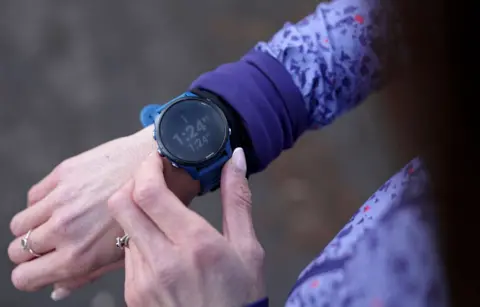
A Sea of Statistics
My thoughts on mine? Currently, irritating. It's indicating my speed is wrong, leading me to doubt whether the foliage along my route are interfering with my satellite signal.
Countless individuals of us fasten these compact monitors onto our arms and keep them on all day and night, seemingly comfortable with the fact they're perpetually tracking us.
A distant memory are the days when we used them exclusively to give us an idea of our daily steps. Today, they can track our sleep quality, heart rate, heart rate variability (HRV), our recovery score.
It's tricky to find a physical metric they don't track.
But do they do what they say they do? And are the data points we analyse a accurate representation of the truth? Do they improve our mental and physical wellbeing, or do the avalanche of metrics and motivational messages just contribute to our sense of overwhelm?

A Complicated Bond
"I find myself getting a a little obsessed with mine," one user admits.
While she values how her device monitors her runs, she finds some of its other features "daunting" at times - a feeling that became apparent during a major life event.
Before she realised she could put it into a specific mode, her smartwatch repeatedly informed her she was failing to be productive enough. In a new phase, the watch frequently reports her she's had a restless night.
"I am caring for a six-month old, it's unnecessary for me to be informed I've not slept," she says. "That fact is only too well."
Is it not possible to just remove it?
"I could, theoretically, but I'm in this push-pull dynamic with it," she explains. "I value it for its fitness insights, I just wonder whether the additional features it can now do is possibly too much for me."
The Technology Behind the Tracking
Each model of smartwatch has its own unique way of measuring your bodily functions and processing your data, but the most use sensors on the back of the watch.
They usually emit tiny, coloured LED lights onto your arm which can observe capillary action, identifying your BPM. Higher-end devices analyse changes in the bioimpedance that flows through the skin to assess your stress levels.
The Professional Viewpoint
A data scientist says that for most people for smartwatches, it's a "difficult line" - while the rapidly advancing tech could actually aid early diagnosis, "identifying issues before we notice anything", it could also turn us device users into the "concerned but fine".
He points out that some of the latest wearables can carry out tests like medical-grade monitoring, which regularly monitor how normal the heart is. They can notify if someone is experiencing atrial fibrillation (AF), where there is irregular electrical activity in the heart causing an irregular heartbeat.
This does not mean someone is about to have a cardiac event, but it can give an early warning they might be more susceptible of a stroke in the long term.
But how to understand these readings is not straightforward. The expert concerns that as further capabilities are added, people may find it hard to fully contextualise their data.
"I'm not entirely convinced that being able to monitor so many metrics is such a beneficial thing," he says.
A clinical psychologist specialising in wearable tech agrees. Research into the impact of wearable tech on a specific group of individuals with health issues suggested a minority of those who were given devices to monitor their cardiac function experienced increased anxiety and were "had a higher tendency to use doctor's time".
She observed a pattern with her patients - they spotted a worrying figure on their watch. They felt anxious. Their heart rate went up. They got even more concerned. They looked a second time, and their heart rate went up again.
"When people are presented with data about ourselves that we don't really understand then, understandably, we are going to want to know more," the psychologist says. "We look, we re-check - it becomes a vicious cycle."

